Cataract symptoms often start quietly: headlights that look like starbursts at night, colors that seem duller, or the need for brighter light to read. These changes usually build slowly, so it is simple to explain them away. This guide covers the most common early cataract symptoms, how they tend to progress, and when to bring them up with an eye doctor. Anaheim Eye Institute has served Orange County since 1958.
You are driving home after dark and the oncoming headlights suddenly bloom into starbursts, scattering light across your windshield in a way they never used to. Or maybe it is the paperback on your nightstand: the print looks fine at the store, but at home you find yourself reaching for a brighter lamp every night. These are classic cataract symptoms, and they are far more common than most people realize. At Anaheim Eye Institute, Orange County’s first multi-specialty ophthalmology practice since 1958, we talk with patients about exactly these kinds of changes every week.
Cataracts develop gradually, often over years, which is part of why they are easy to dismiss. Understanding what early cataract symptoms actually look like and how they tend to progress can help you decide when a conversation with your eye doctor makes sense.
What Exactly Is a Cataract, and Why Does It Cause These Symptoms?
Quick take: A cataract is a clouding of the eye’s natural lens that scatters and blocks light, which is why vision can look blurry, dim, or hazy. It is not an infection or growth on the eye, nor does it spread to other parts of the body.
The lens sits behind your iris (the colored part of your eye) and normally stays clear, focusing light onto the retina at the back of the eye. Over time, proteins in the lens can break down and clump together, forming a cloudy patch. According to the National Eye Institute, this clumping tends to begin around age 40, though it usually takes years before it affects vision enough to notice. As more of the lens clouds over, less light reaches the retina clearly, which produces the classic symptoms of blur, glare, and dullness.
- Cataracts form inside the eye’s natural lens, not on the surface
- The clouding process is typically gradual, not sudden
- Nearly everyone develops some degree of lens clouding by their 80s
The Early Cataract Symptoms People Notice First
Quick take: The earliest cataract symptoms are usually subtle: mild blurring, more glare at night, or colors that look slightly washed out. These changes tend to be gradual, which is precisely why they are easy to overlook at first.
Many patients tell us they assumed they just needed a new glasses prescription, only to learn a cataract was the underlying cause. The American Academy of Ophthalmology notes that blurred or dim vision is often the very first sign, frequently paired with a growing sensitivity to bright light or glare. Some people also notice double vision or a “ghosting” effect in one eye, even with the other eye closed.
- Blurry or hazy vision, even with an updated glasses prescription
- Increased glare or halos around headlights and streetlights at night
- Colors that appear faded, dull, or slightly yellowed
- Needing brighter light for reading, cooking, or close-up hobbies
- Frequent changes to your eyeglass or contact lens prescription
- Double vision or ghost images in one eye
Small, gradual vision changes are worth mentioning at your next eye exam, even if they seem minor.
How Cataract Symptoms Tend to Progress Over Time
Quick take: Cataract symptoms generally worsen slowly over months or years, though the pace varies a lot from person to person. Some people notice a plateau for a long stretch, while others see changes accelerate.
Because progression is usually slow, many patients live with mild symptoms for a long time before they interfere with daily life. The AAO explains that most age-related cataracts stay symptom-free for years, and it is only after the clouding affects a meaningful portion of the lens that vision changes become noticeable day to day. That said, certain cataract types, including some linked to diabetes or long-term steroid use, can progress faster.
- Early stage: mild blur, slightly more glare, otherwise minimal daily impact
- Moderate stage: reading, driving at night, or screen use start to feel harder
- Advanced stage: vision noticeably clouded, colors significantly muted, daily tasks affected
- Timeline: often years between first noticing symptoms and needing surgery, though this varies widely
If you’re noticing your near vision has changed alongside these symptoms, it’s worth having a full eye exam, since some patients are also candidates for procedures like LASIK to address separate refractive issues before cataracts become the primary concern.
Who Is Most Likely to Develop Cataracts, and When
Quick take: Age is the biggest factor in cataract development, but it is not the only one. Certain health conditions and lifestyle factors can raise your risk or speed up the timeline.
Cataracts are strongly associated with aging: the National Eye Institute reports that more than half of Americans age 80 and older either have a cataract or have already had cataract surgery. But plenty of people notice symptoms well before then, and a handful of other factors play a role.
- Age 40 and older: proteins in the lens begin breaking down, though symptoms may not appear for years
- Family history of cataracts
- Diabetes or long-term steroid medication use
- Smoking, heavy alcohol use, or high blood pressure
- Significant UV light exposure over the years, especially without sunglasses
- Previous eye injury or eye surgery
Mayo Clinic also notes that obesity and certain chronic health conditions can add to overall cataract risk, which is one more reason routine eye exams matter as you get older, regardless of whether you’re noticing symptoms yet.
When It May Be Time to Talk to Your Eye Doctor
Quick take: There is no single symptom or age that automatically means it’s time for cataract surgery. The better question is whether your vision changes are starting to get in the way of things you want or need to do safely.
Cataracts do not require immediate treatment just because they are present. According to the AAO, if a cataract isn’t disrupting your daily life, it is often reasonable to wait and revisit the decision later. What matters most is function: can you still drive comfortably at night, read a menu, or recognize a face across the room?
- Night driving feels noticeably less safe due to glare or halos
- Reading, sewing, or screen use requires much brighter light than before
- Glasses or contacts no longer seem to help as much as they used to
- Colors look consistently faded or your vision has a yellowish tint
- Daily tasks like cooking or navigating stairs feel harder because of vision changes
If any of this sounds familiar, it does not mean you need surgery right away. It simply means a conversation with your eye doctor is worth having, so you understand your options and can decide on your own timeline.
Deciding when to treat a cataract is a personal decision, best made together with your eye doctor.
What Happens During a Cataract Evaluation
Quick take: A cataract evaluation is a straightforward, painless process that measures how much the cataract is affecting your vision and overall eye health. It also helps your doctor determine whether other conditions might be contributing to your symptoms.
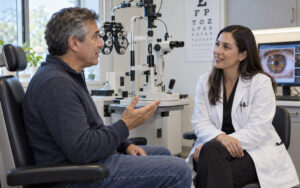
Your doctor will check your visual acuity, examine the lens under magnification, and often dilate your pupils for a closer look at the retina. It’s also a good time to discuss broader vision goals, since some patients are also curious about longer-term options like refractive lens exchange, which replaces the eye’s natural lens with an artificial one before a cataract has fully formed.
- Visual acuity testing at varying distances
- Slit-lamp exam of the lens and front structures of the eye
- Dilated exam to check the retina and optic nerve
- Discussion of your daily activities and how symptoms affect them
Understanding Your Options If Surgery Becomes Appropriate
Quick take: Cataract surgery is one of the most commonly performed and well-studied procedures in medicine, and it involves removing the clouded lens and replacing it with a clear artificial one. The right timing and lens choice depend on your individual eyes, lifestyle, and goals.
If your doctor determines that surgery is a reasonable next step, a few lens options are worth understanding ahead of time. Standard cataract surgery replaces the clouded lens with a fixed-focus artificial lens, while newer technology like the Light Adjustable Lens allows for fine-tuning of your vision after surgery once your eye has healed.
- Vision is typically blurry immediately after surgery, which is expected
- Mild redness, light sensitivity, and grittiness are common in the first few days
- Many patients notice brighter, clearer colors within the first week
- Vision generally stabilizes within two to three weeks, when new glasses can be prescribed
Patients with additional retinal concerns, such as diabetic eye changes or macular degeneration, may also benefit from a coordinated evaluation with our retina specialists before surgery.
Conclusion
Cataract symptoms rarely show up all at once. They tend to creep in gradually, through a bit more night glare, slightly duller colors, or a growing need for brighter light. The key takeaway is simple: you do not have to diagnose yourself or decide alone whether it is “time.” A comprehensive eye exam can tell you exactly what is happening and what your options look like, on your own timeline.
Have questions about your vision or ready to explore your options? The team at Anaheim Eye Institute has been helping Orange County patients see clearly since 1958.
Book an Appointment or call 714.533.2020.
This article is for informational purposes only and is not a substitute for professional medical advice. Please consult your eye doctor for guidance specific to your vision and health.
FAQ
1. What are the very first signs of a cataract? The earliest cataract symptoms are often mild blurring, more sensitivity to glare (especially headlights at night), and colors that look slightly duller than usual. Many people first notice they need brighter light to read comfortably. These changes are usually gradual, so they can be easy to miss at first.
2. Can cataracts be prevented? There is no guaranteed way to prevent cataracts, since aging is the primary driver. However, wearing UV-blocking sunglasses, not smoking, and managing conditions like diabetes and blood pressure may help slow their development. Regular eye exams help catch changes early regardless of prevention efforts.
3. Do cataract symptoms mean I need surgery right away? Not necessarily. Many people live with mild cataract symptoms for years before treatment is needed, and surgery is generally considered when symptoms start interfering with daily activities like driving or reading. Your eye doctor can help you decide on the right timing for your situation.
4. How fast do cataracts usually progress? Most age-related cataracts progress slowly, often over several years, though the pace varies from person to person. Certain factors, such as diabetes or long-term steroid use, can speed up progression in some cases. Regular checkups help track any changes over time.
5. At what age do cataract symptoms typically start? Lens changes can begin as early as your 40s, though most people do not notice symptoms until their 60s or later. By age 80, most people have some degree of lens clouding. Age is a major risk factor, but symptoms and timing vary widely between individuals.