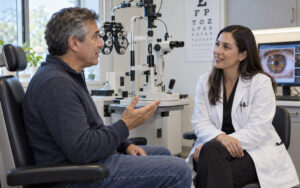
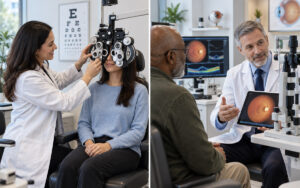
An optometrist holds a Doctor of Optometry degree and handles exams, prescriptions, and many routine eye conditions. An ophthalmologist is a medical doctor who completed residency and can perform eye surgery. For glasses and routine care, either may be appropriate. For cataracts, glaucoma surgery, or retinal disease, you need an ophthalmologist.
You have a floater that will not go away, or your vision has gone hazy at night, and you sit down to book an appointment. Then you reach the point almost everyone does: optometrist vs. ophthalmologist, and you have no clear sense of which one to call.
It is a reasonable confusion. Both are called eye doctors; both can examine your eyes, and in many practices they work in the same building. The distinction is based on training path and scope of practice, and it becomes much more important once your situation moves beyond a prescription update.
Anaheim Eye Institute has been Orange County’s multi-specialty ophthalmology practice since 1958, and this question comes up constantly at the front desk. Here is a clear way to think about it.
What Is the Difference Between an Optometrist and an Ophthalmologist?
An optometrist earns a Doctor of Optometry (OD) degree through four years of optometry school after undergraduate study. An ophthalmologist earns an MD or DO through four years of medical school followed by four years of hospital-based ophthalmology residency and is licensed to perform eye surgery.
That extra training is the core of the difference. According to the American Medical Association, ophthalmologists accumulate more than 12,000 to 16,000 hours of clinical training during residency, and roughly 40% then complete a one- or two-year subspecialty fellowship.
Both are doctors, and both play real roles in eye care. They are not competing versions of the same job; they occupy different points on a continuum from vision correction through medical and surgical treatment.
What Does an Optometrist Do?
Optometrists perform comprehensive eye exams, measure and prescribe glasses and contact lenses, screen for eye disease, and manage many common conditions such as dry eye and minor infections. They are often the first point of contact in eye care and the provider most people see regularly.
For a great many patients, this is exactly the right level of care. If your vision has drifted slightly, your contacts feel less comfortable than they used to, or you are due for a routine check, an optometrist is a sensible first call.
Optometrists also frequently detect the earliest signs of serious disease, including glaucoma and diabetic changes in the retina, and refer patients onward. That screening role is genuinely valuable.
Scope of practice varies by state, and California’s rules differ from those in some other states, so what an optometrist can treat depends partly on where you live. Some states permit optometrists to prescribe a wider range of medications or perform certain minor procedures, while others define the role more narrowly.
Practically, this means the label alone does not tell you everything. If you are being treated for a specific condition rather than simply getting a prescription updated, it is reasonable to ask what your provider’s training covers and when they would refer you.
Most eye care journeys start with an exam, not a surgery, and that is exactly as it should be.
What Does an Ophthalmologist Do?
Ophthalmologists provide the full range of eye care, from routine exams and prescriptions through the medical management of eye disease and surgery. They diagnose and treat conditions including cataracts, glaucoma, retinal disease, corneal disorders, and eyelid problems.
Surgical training is the defining capability. Residency covers preoperative evaluation, surgical risk assessment, anesthetic considerations, and the management of complications, which is the part of surgical care that becomes important precisely when things do not go as planned.
Ophthalmologists also manage the medical side of eye disease that never reaches an operating room: monitoring pressure in glaucoma, adjusting drop regimens, and tracking retinal changes in patients with diabetes. Surgery is the capability that defines the training, but it is a minority of most ophthalmologists’ daily work.
Within ophthalmology, subspecialists focus further. Anaheim Eye includes fellowship-trained specialists in cornea, retina, and oculoplastics, which covers the eyelid and tear duct conditions that are often overlooked in general eye care.
If your condition sits squarely in one of those areas, seeing the matching subspecialist generally beats seeing a generalist with a longer list of credentials. Fit matters more than rank.
Where Do Opticians Fit In?
Opticians are the third category and the one most often confused with the other two. They are trained technicians, not doctors, who fit and dispense eyeglasses and contact lenses based on a prescription written by an optometrist or ophthalmologist.
An optician cannot examine your eyes, diagnose conditions, or write a prescription. What a good optician does exceptionally well is translate a prescription into frames and lenses that actually work for your face, your job, and your daily life.
If you are picking out glasses at an optical shop, you are almost certainly working with an optician, which is entirely appropriate.
Which One Should You See for Your Symptoms?
For routine vision checks and prescription updates, either an optometrist or an ophthalmologist works. For symptoms that suggest disease, or for any condition that may eventually require surgery, an ophthalmologist is the appropriate choice.
A practical way to sort it:
- Start with an optometrist or ophthalmologist: annual exams, blurry vision, prescription updates, contact lens fitting, dry eye
- See an ophthalmologist: cataract evaluation, glaucoma management, retinal conditions, corneal disease, eyelid surgery, LASIK or refractive surgery consultation
- Seek urgent care: sudden vision loss, a curtain or shadow across your vision, a sudden shower of floaters or flashes, eye trauma, or severe eye pain
That last group deserves emphasis. Sudden onset symptoms can indicate a retinal detachment or other emergency, and those are situations where hours matter. Please call your eye doctor or go to an emergency department right away.
Sudden floaters, flashes, or a shadow in your vision are reasons to call today, not next week.
Do You Need a Referral to See an Ophthalmologist?
In most cases, no. Many patients book directly with an ophthalmology practice without a referral, though your insurance plan may have its own requirements, particularly HMO plans and some Medicare Advantage plans.
Check your plan before scheduling if you are unsure. A quick call to the number on your insurance card, or to the practice’s front desk, usually settles it in a few minutes.
If you are already seeing an optometrist and they recommend a referral, that is a normal and appropriate handoff rather than a sign that something is seriously wrong. Screening and referral is precisely how the system is designed to work.
Can You See Both?
Yes, and many people do. A common pattern is seeing an optometrist for annual exams and glasses, while an ophthalmologist manages a specific medical condition such as glaucoma or performs a procedure like cataract surgery.
Co-management arrangements are also routine, where an optometrist handles some pre- and post-operative visits while the ophthalmologist performs the surgery. If this scenario applies to you, ask who will see you at each stage and who to call with concerns.
The goal is not to pick a side. It is to make sure the person looking at your eyes has the right training for what your eyes actually need.
Conclusion
The optometrist vs. ophthalmologist question usually resolves itself once you name your reason for going. Routine vision care is appropriate for either type of eye doctor. Anything medical or surgical belongs with an ophthalmologist, and anything sudden belongs with someone today.
Have questions about your vision or are you ready to explore your options? The team at Anaheim Eye Institute has been helping Orange County patients see clearly since 1958.
Book an Appointment or call 714.533.2020.
This article is for informational purposes only and is not a substitute for professional medical advice. Scope of practice varies by state. Please consult a qualified eye care professional regarding your specific symptoms or condition.
Frequently Asked Questions
Is an optometrist a real doctor? Yes. An optometrist holds a Doctor of Optometry (OD) degree earned through four years of optometry school following undergraduate study. Optometrists are licensed doctors who examine eyes, prescribe corrective lenses, and manage many eye conditions, though they do not attend medical school or perform surgery.
Can an optometrist perform cataract surgery? No. Cataract surgery is performed by ophthalmologists, who are medical doctors with four years of residency training that includes surgical technique, anesthesia, and complication management. Optometrists may participate in pre- and post-operative care through co-management arrangements.
Which eye doctor should I see for glaucoma? An ophthalmologist typically manages glaucoma, particularly when laser treatment or surgery may be needed. Optometrists often detect elevated eye pressure during routine exams and refer patients onward. Scope of practice for glaucoma medication management varies by state.
Do I need a referral to see an ophthalmologist? Usually not. Most patients can schedule directly with an ophthalmology practice. Some insurance plans, particularly HMOs and certain Medicare Advantage plans, require a referral first, so check with your plan before booking.
What is the difference between an optician and an optometrist? An optician is a trained technician who fits and dispenses glasses and contact lenses based on an existing prescription. An optometrist is a doctor who examines eyes, diagnoses conditions, and writes prescriptions. Opticians do not perform eye exams.