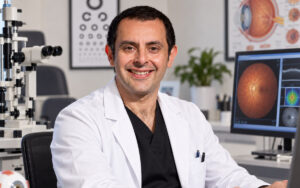
Dr. M. Reza Neal has served as medical director of the Anaheim Eye Institute since 2005 and has performed more than 40,000 surgical procedures. Research from a Swedish registry of 118,000 cataract surgeries found complication rates fall sharply as surgeon volume rises. This article explains his background and what his experience can and can not tell you.
Introduction
In a Swedish national registry of more than 118,000 cataract operations, surgeons performing fewer than 100 cases a year had a serious complication rate of 2.15%. Among surgeons performing more than 1,000 cases a year, that rate dropped to 0.48%. This represents roughly a fourfold difference, based on one of the largest datasets in ophthalmology.
That finding is the most useful lens through which to understand Dr. Neal at Anaheim Eye Institute, whose profile lists more than 40,000 surgical procedures over two decades as medical director. Numbers like that are deceptively simple to put on a website and harder to interpret.
So this is not a list of accolades. It is an attempt to explain what a surgeon’s training and volume actually mean when you are sitting in the chair, deciding whether to trust someone with your vision, and why Anaheim Eye’s presence in Orange County since 1958 is part of that same story.
Why Experience Became the Central Question in Eye Surgery
Cataract and refractive surgery are, in one sense, remarkably routine. Cataract removal is among the most frequently performed operations in American medicine, and the vast majority of cases go smoothly regardless of who performs them. That very routineness is what makes the experience question so subtle.
The difference between surgeons rarely shows up in the ordinary case. It shows up in the unusual one: the dense, mature cataract that resists standard technique, the eye with a weak lens capsule, and the patient whose anatomy does not match the textbook. Those are the moments when a surgeon’s accumulated judgment is most important, and they can come unexpectedly.
Researchers have tried to quantify these instances. The Swedish National Cataract Register analysis covering 2007 to 2016 found a steady inverse relationship between annual case volume and posterior capsule rupture, the most significant intraoperative complication in cataract surgery. The curve flattens above roughly 500 cases a year, but the improvement across the lower ranges is substantial.
The researchers were careful to note a caveat worth repeating. High-volume surgeons in the study also tended to operate on slightly lower-risk patients, so some of the gap reflects patient selection rather than skill alone. The honest reading is that volume matters, but it is not the only thing that matters.
The Path Behind the Number
Dr. Neal’s training runs through a sequence of institutions that each add a different layer. He completed his undergraduate degree at Harvard University in 1989, a master’s degree at the University of Pennsylvania in 1994, and his medical degree at Wayne State University School of Medicine in 2000.
His ophthalmology residency was at Vanderbilt University, completed in 2004, followed by fellowship training in advanced ophthalmic surgery at the New York Eye and Ear Infirmary in 2005. Fellowship is the step that distinguishes a general ophthalmologist from a subspecialist, and according to the American Medical Association, only about 40% of ophthalmologists complete one.
He has been a Diplomate of the American Board of Ophthalmology since 2005, a Fellow of the American Academy of Ophthalmology since that same year, and a Fellow of the American Society of Cataract and Refractive Surgery since 2006. Verify board certification for any surgeon you are considering; you can check it directly through the American Board of Ophthalmology.
He became medical director of the Anaheim Eye Institute in 2005 and has held that role for roughly twenty years. The 40,000 procedures accumulated over that time include laser vision correction, cataract surgery, and corneal transplantation.
What a Surgeon Builds Over Twenty Years
Volume is not just repetition. Over two decades, a surgeon accumulates a library of variations: the eyes that behaved unexpectedly, the techniques that worked when the first approach did not, and the early signals that a case is about to become complicated.
That library also shapes judgment about who should be denied surgery or have it later. Deciding against operating, or recommending a different procedure than the one a patient came in asking for, is a skill that only develops through seeing enough outcomes to know what predicts them.
It shows up in technology decisions too. Dr. Neal was among the early adopters of laser-assisted cataract technology in the region, and Anaheim Eye now uses the LenSx laser system along with ORA (Optiwave Refractive Analysis), which measures the eye during surgery to verify intraocular lens power in real time. He also founded the Surgical Center of Anaheim Hills, a Medicare-credentialed ambulatory surgery center built specifically for eye procedures.
A dedicated eye surgery center is a quieter credential than a procedure count, but it reflects the same thing: doing one kind of work often enough that the entire environment gets optimized around it.
Experience shows up most clearly in the cases that do not go according to the textbook.
What Experience Does Not Promise
No surgeon, at any volume, can guarantee a result. Eyes heal differently, underlying conditions vary, and every procedure carries some risk. A high procedure count shifts the odds in your favor; it does not remove uncertainty, and any practice that suggests otherwise is overselling.
Experience also does not substitute for fit. A surgeon who explains things in a way that leaves you confused, or who seems impatient with your questions, is not the right surgeon for you regardless of credentials. Vision surgery is elective often enough that you can afford to care about the details.
And experience is procedure-specific. A surgeon with enormous cataract volume may do relatively little oculoplastic or retinal work, which is why multi-specialty practices exist. Anaheim Eye’s model, established as Orange County’s first multi-specialty ophthalmology practice, includes fellowship-trained specialists in cornea, retina, and oculoplastics to match patients with the right subspecialist instead of just the available one.
How to Read Any Surgeon’s Credentials
If you are evaluating surgeons, whether at Anaheim Eye or anywhere else, the useful questions are more specific than “How experienced are you?” Ask how many of your particular procedures the surgeon performs in a typical year, since annual volume is what the research actually measures. Ask what their approach would be if something unexpected occurred during your case.
Verify board certification independently rather than relying on a website’s claims. Ask whether the surgeon has fellowship training and in what subspecialty, and whether that subspecialty matches your condition. Ask who will handle your follow-up care and whether you will see the surgeon at those visits.
Then pay attention to something harder to measure: whether the surgeon tells you about risks without being asked and whether they are willing to say that a procedure you are interested in might not be right for you. Candor about limits is one of the more reliable markers of genuine expertise.
Conclusion
That fourfold difference in complication rates between low- and high-volume surgeons is real, and it is one important reason to care about experience when choosing who operates on your eyes. It is also only part of the picture, sitting alongside training, subspecialty match, honest communication, and whether the practice will still be there for your follow-up care.
Have questions about your vision, or are you ready to explore your options? The team at Anaheim Eye Institute has been helping Orange County patients see clearly since 1958.
Book an Appointment or call 714.533.2020.
This article is for informational purposes only and is not a substitute for professional medical advice. Surgical outcomes vary by individual, and no result can be guaranteed. Please consult your eye doctor regarding your specific diagnosis and treatment options.
Frequently Asked Questions
Who is Dr. Neal at Anaheim Eye Institute? Dr. M. Reza Neal, MD, has served as Medical Director of the Anaheim Eye Institute since 2005. He trained at Harvard, the University of Pennsylvania, Wayne State University School of Medicine, Vanderbilt University, and the New York Eye and Ear Infirmary and specializes in laser vision correction, cataract surgery, and corneal transplantation.
How many procedures has Dr. Neal performed? His practice profile lists more than 40,000 surgical procedures performed over roughly two decades as medical director of the Anaheim Eye Institute. These span laser vision correction, cataract surgery, and corneal transplantation.
Does a surgeon’s experience affect cataract surgery outcomes? Research suggests it does. A Swedish registry study of over 118,000 procedures found that surgeons performing 10 to 99 cases annually had a 2.15% posterior capsule rupture rate, compared with 0.48% among those performing more than 1,000 cases. Researchers noted that patient selection accounts for part of this difference.
What does fellowship training mean for an ophthalmologist? Fellowship is one to two years of subspecialty training that is completed after a four-year ophthalmology residency. About 40% of ophthalmologists complete one. It indicates focused expertise in an area such as cornea, retina, or oculoplastics.
How can I verify an eye surgeon’s board certification? You can check certification status directly through the American Board of Ophthalmology at abop.org. Board certification indicates the surgeon has met national standards for training and passed comprehensive examinations, and it is worth verifying independently rather than relying on a practice website.