Your first visit to Anaheim Eye Institute typically takes 60 to 90 minutes and includes vision testing, eye pressure measurement, a slit lamp exam, and usually dilation. Bring your glasses, current medications, insurance card, and ideally a driver, since dilation blurs near vision and increases light sensitivity for several hours.
Introduction
You booked the appointment weeks ago, and now that it is tomorrow, you are wondering what you actually signed up for. Will they touch your eyes? Will you be able to drive yourself home? Is this the appointment where someone tells you something you would rather not hear?
Those questions are more common than most people realize, and they are worth answering plainly. A first visit to Anaheim Eye Institute is a comprehensive eye evaluation, which means it is longer and more thorough than a quick vision screening at the DMV or a school nurse’s office.
Anaheim Eye has been examining Orange County eyes from its La Palma Avenue location since 1958, and new patient visits follow a fairly predictable rhythm. Here is the whole process, from start to finish.
How Long Does the First Visit Take?
Quick take: Plan for 60 to 90 minutes. A comprehensive eye exam generally runs 30 to 90 minutes depending on which tests are needed, and a first visit sits at the longer end because of new patient paperwork and a full medical history.
Most of the individual tests take only a few minutes each. What stretches the appointment is the waiting: dilating drops need roughly 20 to 30 minutes to take full effect before the doctor can examine the back of your eye.
Arrive about 15 minutes early if you have not completed forms in advance. If you are coming for a specific concern such as a LASIK evaluation or a cataract assessment, additional imaging may extend the visit further.
- Check-in and paperwork: 10 to 15 minutes
- Technician workup and initial testing: 15 to 20 minutes
- Dilation waiting period: 20 to 30 minutes
- Doctor examination and discussion: 15 to 25 minutes
What Should You Bring?
Quick take: Bring your insurance cards, photo ID, current glasses and contact lenses, a list of all medications, and your family eye health history. If you wear contacts, bring the box or a photo of the prescription details.
Family history matters more in eye care than most patients expect. Conditions including glaucoma and macular degeneration carry a meaningful hereditary component, so knowing whether a parent or sibling was diagnosed changes how closely certain findings are watched.
A short checklist for the night before:
- Medical and vision insurance cards, plus photo ID
- Your current glasses, sunglasses, and contact lens boxes
- A complete list of medications and supplements, including doses
- Any known family history of eye disease
- A written list of your symptoms and questions
- Sunglasses for the drive home, and ideally a driver
The question you forget to ask in the room is the one you will think about all week.
Should You Stop Wearing Contact Lenses Beforehand?
Quick take: For a routine exam, you can usually wear contacts and remove them at the office. For a LASIK or refractive surgery evaluation, you will typically be asked to stop wearing them in advance, because contacts temporarily reshape the cornea.
Soft lenses generally require a shorter break than rigid gas-permeable lenses, and the practice will give you specific instructions when you schedule. Skipping this step can produce measurements that do not reflect your true corneal shape.
If your appointment is for a surgical consultation, please call ahead to confirm the required contact lens holiday rather than assuming it. Measurements taken too soon usually have to be repeated.
Which Tests Will Be Performed?
Quick take: A comprehensive exam typically includes visual acuity testing, refraction, pupil response, eye movement, eye pressure measurement, a slit lamp examination of the front of the eye, and a dilated look at the retina and optic nerve.
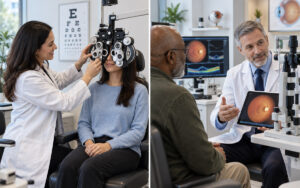
None of these are painful. Eye pressure measurement involves numbing drops and a brief, light touch to the surface of the eye, or in some offices a puff of air instead. The slit lamp is simply a microscope with a bright light, and you rest your chin and forehead against a support while the doctor looks.
Here is what each main test is checking, as outlined in All About Vision’s guide to comprehensive eye exams:
- Visual acuity: how sharp your vision is at distance and near, using the familiar letter chart
- Refraction: your glasses prescription, determined by comparing lenses through a phoropter
- Tonometry: the pressure inside your eye, a key screening measure for glaucoma risk
- Slit lamp exam: the health of your cornea, lens, iris, and eyelids
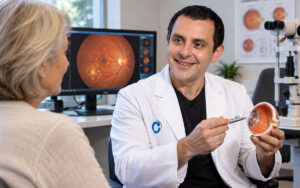
- Dilated retinal exam: the retina, optic nerve, and blood vessels at the back of the eye
- Visual field: your peripheral vision, often added when glaucoma is a concern
Depending on your symptoms, the doctor may add corneal mapping, retinal imaging, or other specialized testing.
A dilated exam is one of the few ways to see blood vessels and nerve tissue directly, without a single incision.
What Does Dilation Feel Like, and How Long Does It Last?
Quick take: Dilating drops sting slightly for a few seconds, begin working in about 20 to 30 minutes, and leave your near vision blurry and your eyes light-sensitive for several hours. Distance vision is usually less affected than reading vision.
The drops relax the muscle that controls your pupil so it stays wide open, which gives the doctor a clear view of the retina and optic nerve. That same effect is what makes bright light uncomfortable afterward.
Most patients are comfortable driving short, familiar distances in daylight with sunglasses, but plenty are not. If it is your first dilated exam, you do not yet know which group you are in.
- Arrange a ride if you can, especially for a first visit
- Bring sunglasses even on an overcast day
- Expect difficulty reading your phone or a menu for a few hours
- Plan not to return to detailed close-up work immediately afterward
Will Your Insurance Cover the Visit?
Quick take: It depends on why you are coming. A visit prompted by a medical symptom or condition is typically billed to your medical insurance, while a routine visit for glasses or contacts is usually billed to a vision plan. Many patients carry both.
This distinction surprises people, and it is worth sorting out before you arrive rather than at checkout. If you come in for blurry vision and the doctor finds a cataract, the visit becomes a medical one regardless of how you booked it.
Bring both cards if you have them, and tell the front desk your main reason for the visit so they can route the claim correctly.
- Medical insurance: symptoms, eye disease, injury, post-surgical care, diabetic eye exams
- Vision plan: routine exams, glasses prescriptions, contact lens fittings
- Either may apply: a visit that starts routine and uncovers a medical finding
- Ask upfront: whether the practice is in-network for both plans
What Happens After the Exam?
Quick take: The doctor reviews findings with you, explains any conditions identified, and recommends next steps. That may be an updated prescription, a follow-up interval, additional testing, or a referral to a subspecialist within the practice.
Anaheim Eye is a multi-specialty practice, with fellowship-trained specialists in cornea, retina, and oculoplastics. That means findings in one area can often be handled in-house rather than requiring a referral elsewhere.
This is the part of the visit where your written question list earns its keep. Dilated vision makes note-taking challenging, so consider bringing someone with you or asking whether you can record the summary.
Reasonable things to ask before you leave:
- What did you find, and does anything need watching?
- When should I come back, and why that interval?
- Is my prescription changing, and by how much?
- Are there any symptoms that would warrant an earlier call?
Conclusion
A first visit to Anaheim Eye Institute is longer than a vision screening because it is doing something different: looking at the health of your eyes, not just the sharpness of your sight. Come with your glasses, your medication list, your questions, and if you can manage it, a ride home.
Have questions about your vision, or are you ready to explore your options? The team at Anaheim Eye Institute has been helping Orange County patients see clearly since 1958.
Book an Appointment or call 714.533.2020.
This article is for informational purposes only and is not a substitute for professional medical advice. Exam components vary based on individual needs. Please consult your eye doctor for a personal diagnosis or treatment recommendations.
Frequently Asked Questions
How long does a first eye exam appointment take? Plan for 60 to 90 minutes. Comprehensive eye exams generally run 30 to 90 minutes, and first visits sit at the longer end because of new patient paperwork, a full medical history, and the 20 to 30 minute wait for dilating drops to take effect.
Will my eyes be dilated at my first visit? Usually yes. Dilation is standard in a comprehensive exam because it allows the doctor to see the retina and optic nerve clearly. In some situations the doctor may use retinal imaging instead, but you should plan for dilation unless told otherwise.
Can I drive myself home after an eye exam? Many patients can, but dilation causes blurred near vision and light sensitivity for several hours. If this is your first dilated exam, arranging a ride is the safer choice. Bring sunglasses regardless of how you get home.
Do I need to stop wearing contact lenses before my appointment? For a routine exam, no. For a LASIK or refractive surgery evaluation, yes, because contact lenses temporarily change the shape of your cornea. Call the office for specific timing, which differs for soft versus rigid gas-permeable lenses.
What should I bring to my first visit to Anaheim Eye Institute? Bring your medical and vision insurance cards, photo ID, current glasses and contact lens information, a complete medication list, your family eye health history, and a written list of symptoms and questions. Sunglasses are useful for afterward.